





Unresectable Hepatocellular Carcinoma (uHCC)
Unresectable Hepatocellular Carcinoma (uHCC):
A Comprehensive Overview 2026
What Is uHCC?
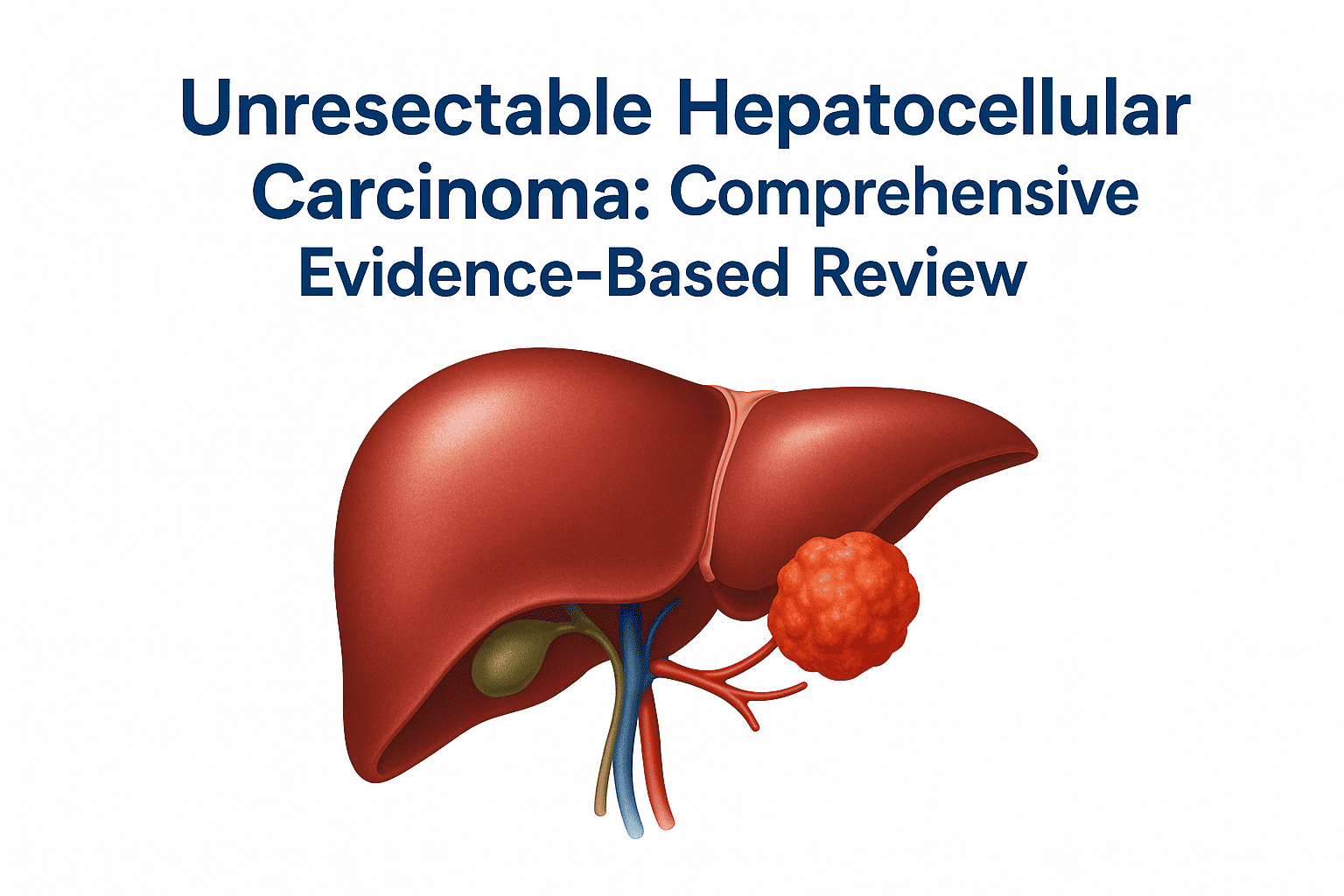
Hepatocellular carcinoma (HCC) is the most common form of primary liver cancer. Unresectable hepatocellular carcinoma (uHCC) is defined as disease that is multinodular and unresponsive to locoregional therapies, diffusely infiltrative with bi-lobar involvement, or characterized by portal vein invasion and/or extrahepatic spread, in patients who have preserved liver function and adequate performance status, in alignment with Barcelona Clinic Liver Cancer (BCLC) criteria.
HCC is the sixth-leading cause of cancer-related death in the United States, with an estimated 41,630 new diagnoses and 29,840 deaths in 2024. Globally, HCC ranks as the sixth most common cancer and third in cancer-related mortality. The median age at diagnosis is 67 years, and incidence rates for males are 2 to 3 times greater than for females due to an imbalance in risk factors. The 5-year relative survival rate remains low, at 21.7%, highlighting the aggressive nature of HCC and the need for improvements in treatment.
Epidemiology & Risk Factors
HCC is most commonly found in the context of liver cirrhosis and, in rare cases, in a healthy liver. Its prevalence has risen in recent years, particularly in Western nations, due to the increasing frequency of non-alcoholic fatty liver disease.
Advances in next-generation sequencing (NGS) have greatly expanded understanding of the molecular drivers of hepatocarcinogenesis, revealing a heterogeneous landscape marked by recurrent somatic mutations, structural variations, and dysregulated signaling pathways. Among the most common genetic alterations in HCC are TERT promoter mutations, present in approximately 60% of tumors. Key dysregulated pathways — such as VEGF/VEGFR and TGF-β — are closely associated with uHCC, especially in the presence of macrovascular invasion or extrahepatic spread.
Staging & Patient Selection
The Barcelona Clinic Liver Cancer (BCLC) staging system is widely used to guide treatment selection based on tumor burden, liver function, and patient performance status. While curative options such as surgical resection, local ablation, and liver transplantation are available for patients with early-stage disease, those with intermediate (BCLC-B) or advanced-stage (BCLC-C) disease who are not candidates for transplantation require systemic therapy.
Recent guidelines from the American Association for the Study of Liver Diseases (AASLD) strongly recommend systemic therapy for patients with preserved liver function (Child–Turcotte–Pugh class A or B7), an ECOG performance status of 0–1, and BCLC stage C disease.
Treatment Landscape
Historical Standard of Care: Sorafenib
For many years, the only proven therapy for uHCC was sorafenib, a tyrosine kinase inhibitor. Sorafenib was approved in 2007 based on a survival benefit versus placebo. The Asia-Pacific phase 3 trial showed median overall survival (OS) of 6.5 months for sorafenib versus 4.2 months for placebo.
The Immunotherapy Revolution
The field was transformed when combination immunotherapy was shown to outperform sorafenib:
1. Atezolizumab + Bevacizumab (IMbrave150)
The IMbrave150 trial (2020) evaluated atezolizumab (PD-L1 inhibitor) in combination with bevacizumab (VEGF inhibitor) compared to sorafenib in unresectable HCC. Overall survival was improved at 12 months (67.2% vs 54.6%), with an improvement in median PFS of 2.5 months (6.8 vs 4.3 months). Extended follow-up demonstrated a median overall survival of 19.2 months compared to 13.4 months in the sorafenib group. This established atezo/bev as the new standard of care.
2. Tremelimumab + Durvalumab (HIMALAYA / STRIDE Regimen)
The HIMALAYA trial demonstrated that the STRIDE regimen — comprising a single priming dose of tremelimumab (Imjudo) plus durvalumab (Imfinzi) followed by durvalumab alone — improved median OS compared with sorafenib (16.43 vs 13.77 months), achieving a 22% reduction in the risk of death. This was the first FDA approval demonstrating an improvement in survival for combination immunotherapies in HCC, and the first approved indication for tremelimumab.
3. Nivolumab + Ipilimumab (CheckMate 9DW) — Approved April 2025
The FDA approved nivolumab (Opdivo) in combination with ipilimumab (Yervoy) for the first-line treatment of adult patients with unresectable or metastatic HCC in April 2025, supported by the phase 3 CheckMate 9DW trial. At a median follow-up of 35.2 months, patients who received nivolumab plus ipilimumab achieved a median OS of 23.7 months vs 20.6 months for those treated with sorafenib or lenvatinib, translating to a 21% reduction in the risk of death. The combination also yielded one of the highest objective response rates (ORRs) seen in first-line uHCC at 36%, compared with 13% with TKIs.
Medicines Currently Approved for uHCC
🟢 First-Line Therapies
| Drug | Brand | Mechanism | Key Trial |
|---|---|---|---|
| Atezolizumab + Bevacizumab | Tecentriq + Avastin | PD-L1 + anti-VEGF | IMbrave150 |
| Tremelimumab + Durvalumab | Imjudo + Imfinzi | CTLA-4 + PD-L1 (STRIDE) | HIMALAYA |
| Nivolumab + Ipilimumab | Opdivo + Yervoy | PD-1 + CTLA-4 | CheckMate 9DW |
| Sorafenib | Nexavar | TKI (multi-kinase) | SHARP |
| Lenvatinib | Lenvima | TKI (VEGFR/FGFR) | REFLECT |
🟡 Second-Line Therapies
For patients receiving first-line sorafenib or lenvatinib monotherapy, subsequent options include a different TKI, ramucirumab, nivolumab with ipilimumab, or durvalumab. Immune checkpoint inhibitor monotherapy with pembrolizumab or nivolumab may also be considered after sorafenib or lenvatinib failure.
Regorafenib and cabozantinib are suggested for use as second-line drugs in the event that disease progresses after sorafenib.
| Drug | Brand | Mechanism | Key Trial |
|---|---|---|---|
| Regorafenib | Stivarga | TKI | RESORCE |
| Cabozantinib | Cabometyx | TKI (MET/VEGFR2/AXL) | CELESTIAL |
| Ramucirumab | Cyramza | Anti-VEGFR2 mAb | REACH-2 |
| Pembrolizumab | Keytruda | PD-1 inhibitor | KEYNOTE-394 |
| Nivolumab | Opdivo | PD-1 inhibitor | CheckMate 040 |
Drugs Under Clinical Investigation
Rivoceranib + Camrelizumab (CARES-310)
The CARES-310 study — an international, randomized, open-label Phase 3 trial with 543 patients with uHCC — reported a median overall survival of 23.8 months, the longest mOS for any treatment in a global Phase 3 trial for patients with uHCC. An FDA NDA resubmission was filed with a PDUFA target date of March 2025 and the combination is already approved in China under the brand name AiRuiKa® + rivoceranib.
Tiragolumab + Atezolizumab + Bevacizumab (MORPHEUS-Liver)
The MORPHEUS-Liver Phase Ib/II study found that the addition of tiragolumab (a TIGIT inhibitor) to atezolizumab + bevacizumab resulted in higher objective response rates and longer progression-free survival compared with atezo + bev alone, with no new safety signals identified.
SIERRA Trial (NCT05883644)
The SIERRA trial is a phase 3b, single-arm, multicenter study assessing the safety and efficacy of the STRIDE regimen in a broader patient population with unresectable HCC and a poorer prognosis, such as those with Child-Turcotte-Pugh class B, a higher performance status score, or patients with portal vein thrombosis — populations previously excluded from major trials.
LIVERATION Trial (NCT05201404)
The LIVERATION trial is a phase 3, double-blind, placebo-controlled study assigning patients with advanced HCC and CTP class B7 cirrhosis who have progressed on at least first-line therapy to namodenoson or placebo. Namodenoson is an A3 adenosine receptor (A3AR) agonist that deregulates the NF-kB and Wnt signaling pathways, leading to an increase in pro-apoptotic proteins and inhibition of tumor growth.
TACE + Systemic Therapy Combinations
Ongoing trials are examining the addition of systemic therapy to locoregional liver-directed therapies. The EMERALD-1 trial compared durvalumab with or without bevacizumab combined with transarterial chemoembolization (TACE) in patients with unresectable HCC amenable to embolization.
Other Emerging Combinations
Multiple studies are exploring combinations including tislelizumab plus lenvatinib, sintilimab plus lenvatinib for conversion therapy, donafenib combined with hepatic artery infusion chemotherapy (HAIC) plus sintilimab, and ociperlimab plus tislelizumab plus bevacizumab biosimilar — all currently in Phase II evaluation.
Locoregional Therapies
Intermediate-stage HCC patients with retained liver function, particularly uHCC without extrahepatic metastasis, may benefit from trans-arterial chemoembolization (TACE). This remains standard for BCLC-B patients who are not eligible for systemic therapy or who may be downstaged for resection or transplant.
Summary & Outlook
“HCC has benefitted from the development of multiple novel systemic therapies over the past 5 years. After a decade of only sorafenib, we have five positive front-line regimens and other approved therapies in subsequent treatment lines,” said Dr. Mark Yarchoan of Johns Hopkins.
The past decade has seen a transformative expansion in systemic therapy options for HCC, enabling more individualized treatment strategies, particularly for patients with intermediate- and advanced-stage disease. Still, challenges remain: no biomarkers reliably predict which patients will respond to immunotherapy, and outcomes for patients with Child-Pugh B liver function or portal vein thrombosis remain suboptimal.
📚 Confirmed Reference Links
- PMC – Systemic Treatment for uHCC (2023):
- MDPI – Systemic Therapy for uHCC: Current Landscape and Future Directions (2025):
- Pharmacy Times – Updates in Treatment of uHCC (Feb 2026):
- OncLive – FDA Approves Nivolumab + Ipilimumab for uHCC (April 2025):
- PMC – FDA Approval Summary: Tremelimumab + Durvalumab:
- GlobeNewswire – Rivoceranib + Camrelizumab FDA NDA (CARES-310):
- ASCO Educational Book – Systemic Therapy Updates:
- ASCO Post – Guideline Update for Advanced HCC (2024):
- The Oncologist – Atezo/Bev vs Durva/Treme Real World Study:
- MORPHEUS-Liver Phase Ib/II (ASCO JCO):
- GI Oncology Now – Ongoing HCC Research:
- PeerJ – Tislelizumab + Lenvatinib in uHCC (2026):
- Oncology News Central – Fast Pace of Drug Development in HCC:
⚕️ This article is for informational purposes only. All treatment decisions must be made by qualified oncologists in consultation with the patient’s full clinical profile.